With my morning coffee…

Every morning I like to read through the latest sailing news.  In addition to the many blogs I read, I love to scan Tom Sitzman’s Sail1Design email.  This morning’s issue included a good article on the mental game of sailing.  Check out out below and consider liking them on Facebook or signing up for their emails!

Honing Your Mental Game

by Dr. Tim Herzog, Mental Skills Coach

Sailing is a unique sport with many facets.  Success comes from overall training plan encompassing development of technical expertise, boat speed, strategy, boat handling, tactics, physical training, and mastery of the mental game.  In interviews with Olympians, professionals, or other top athletes, successes or failures are often attributed to cognitive or emotional experiences.  Elite sailors control as many controllables as possible, and yet…  sometimes mental skills are sometimes left up to chance.

You wouldn’t go to a big regatta expecting to consistently go fast without having first worked on boatspeed.  How could you expect mental consistency without having first trained the mind?

Training needs always vary from sailor to sailor, and the first step to honing any skill is too build awareness.  Awareness in boatspeed could mean tuning into components of the experience like degree of heel.  Likewise, noticing your thoughts moment to moment enables greater influence toward more consistently helpful thought patterns.

A good frame of mind can lead to time “in the zone” (as media labels it) or experiencing “flow” (as researchers call it).  You can’t make a flow state occur, but you can set the stage such that falling into it becomes more likely.  Understanding concepts and knowing your own strengths and weaknesses allows for a more intentional setting the stage.  Skills that I often dive into with clients include: goal-setting, clearing cognitive clutter, energy management, mindful attention, mental imagery, and effective communication.

Winning events or medals are obvious carrots to chase after, but thinking about trying to win (or dwelling on fear of bad performance) usually has nothing to do with tasks at hand (like observing sail shape or having a solid tack).  I often work with athletes on setting goals centered on processes in the NOW.  Similarly, our brains are often filled with chatter that is adaptive or maladaptive.  At times when thoughts are actually helpful, it’s akin to riding a good wave- you want to allow it for as long as possible.  But when thoughts are maladaptive, it is like Laser sailing in the trough of a wave that is sending you into a pitchpole… that wave needs to be rolled.  I work with athletes on rolling past less helpful thoughts, sometimes with hard counters, and more often utilizing mindfulness techniques.

An athlete’s energy management is influenced by some of these same factors, plus lifestyle choices, and through psychophysiological techniques like developing an optimally paced breath.  This makes a difference on and off the water, especially in the midst of stressful tactical situations.  Energy management techniques can also contribute to more flexible attention.  Demonstrating that we usually can’t “control” attention, I often tell sailors “don’t think about pink elephants.”   Close your eyes for 10 seconds and try it.  Your brain is likely already filled with pink elephants.  We might not be able to control attention, but we can be mindful about steering it directions that are more helpful, creating attention habits through good routines.  Mental (movement-focused) imagery can be a useful to sailors and other athletes across situations such as: preparing for certain regatta sites, honing a boat handling skill, spontaneous usage on or off the race course, or by combining it with traditional coaching techniques such as video analysis.

With coaches and others, I often work on good communication skills.  Contrary to popular belief, it is not a pre-requisite for teams to get along socially.  “Task cohesion” is much more important than “social cohesion.”  Sailors need to know that they can count on important people like their coaches or their crew.  And when everything else (including trust) is in place, good social relationships can add a synergy to the package.  It makes the experience fun and can fuel motivation.  Whether communicating task needs or social needs, learning a balance between a directive and collaborative style can make all the difference…and making sure that the other person feels heard.  Cliché but true, we have two ears and one mouth for a reason!

Formats for the work I do with sailors and athletes can vary.  Ideal training can involve ongoing individual consultation for coaches and/or sailors, and can incorporate in-person meetings for teams.  Given that I currently live in ski country, coming to Montana can be a great get-away for teams that want to ski by day and learn mental skills by morning and night.

Folks can get a taste of the work by joining a six-part webinar series that I am beginning this Friday.  Log into http://reachingahead.com/index.php?page=about&family=coaching&category=02–Optimal_Sailing&display=76 for more details, or go directly tohttps://www.surveymonkey.com/s/sailingwebinar to sign up!

FROM THE EXPERTS: Tips to launch the spring season

KWR1223-300x199

Sailing Scuttlebutt caught one of our favorite racing pro’s for an article recently.  If you don’t subscribe to the free daily sailing news… you are missing out!  Here is an excerpt of a recent article published in Scuttlebutt:

Born into a sailing family, with a father who was one of the founders of Annapolis’s Severn SA (SSA), and having crewed with his family at a young age, Jonathan Bartlett had a leg up on sailing long before he started teaching it at SSA as a teenager and then working at North Sails in the mid-1980s. Now co-manager with Will Keyworth at North’s Eastport office, Bartlett sails with multiple winning crews personally and professionally.

Most recently, he served as tactician on Robin Team’s J/122 Teamwork for the crew’s third victory in PHRF 1 at Quantum Key West Race Week. In the March edition of SpinSheet, he shares some insights for Chesapeake racing sailors as they launch their spring seasons.

SB: What are the top three things you see successful race teams do before a regatta even begins?

JB: “1) Organization. Everything comes out of that. 2) Keep equipment (including sails) perfect. 3) Practice.”

SB:  Can you list a few drills a sailing team can do for practice?

JB: “I like to see a team practice stopping the boat and then get going again. Practice going from a dead stop to maximum speed. As Wayne Bretsch noted (in the Chesapeake Racer Profile in the January issue), so many boats end up parked at the start… Also, if you have a chance to do drills with a coach, utilize that outside set of eyes. If you go to Key West on the Melges 32 course, for example, you see so many coach boats out there. It doesn’t have to be the best coach or even a coach at all; it has to be someone observant. Video is great, too. It gives you so much basic information, such as how a boat sits on its lines.”

SB: Any tips on nailing the start?

“Have someone set a start line, and have him watch the line as you sail to it. Get your bowman to raise his hand when he thinks you’re on the line. He’s usually a boat length off. Then practice until the bowman has it right.”

SB: Is there a common mistake you see out on the race course when it comes to sail trim?

“Jib leads are often way too far forward.”

SB: Do you have any tips on overall communication onboard?

JB: “Have a crew boss, generally not the skipper or navigator. Discuss upcoming maneuvers. Delegate responsibilities, and share the workload.” – SpinSheet, read on

Spring Refresher – Rules of the road

Every spring thousands of sailor pull the covers off their boats, rig the lines and hoist their sails for the first time.  Even the most seasoned sailors should consider taking a few minutes to review their fundamentals, safety gear and standard

Rules of the road

procedures to ensure the season starts off right.  Over the next few weeks we will be looking at a series of topics designed to get you refreshed and ready to sail.

If you sail in a busy area, like Baltimore’s Inner Harbor or the mouth of the Severn River in Annapolis, knowing the rules of the road will arm you with the knowledge to safely navigate what can be a daunting maze of zipping powerboats, tacking sailboats and working boats like tugs and taxis.

I recently had a conversation with veteran J World Annapolis Coach and Chesapeake Boating Club Baltimore staffer Koralina Pior, and asked her to tell me a little about how she teaches (and remembers herself) the rules of the road.  Below is an excerpt from that conversation.

KB: The rules of the road can seem daunting to even seasoned sailors.  What are the basics that people need to know before they hit the water?

KP: “Before we get started lets briefly define some helpful terms-

  • Stand-on vessel: The stand on vessel is the boat that has right-of-way. The Stand-on vessel is required to maintain course and speed.
  • Give-way vessel: The give-way vessel is the boat that must keep clear of the stand-on vessel. The Give-way vessel is required to make a clear and obvious change in course to alert the stand-on vessel of their intentions.”
KB: The definitions are helpful, but is there any sort of pecking order to who has right of way when two boats come together head to head, in crossing or overtaking situations?

KP: “In fact there is!  Remembering the pecking order is important, because it will quickly answer the first question about who is the stand-on and who is the give-way vessel.  Simply put (and worth memorizing), the hierarchy of right-of-way is:

  • Overtaken vessel
  • Vessels not under command
  • Vessels restricted in their ability to maneuver
  • Vessels constrained by draft
  • Fishing vessels engaged in fishing, with gear deployed
  • Sailing vessels
  • Power driven vessels

Each of these terms is defined in the International Regulations for Preventing Collisions at Sea.  For instance a “fishing vessel”, is defined any vessel fishing with nets, lines, trawls, or other fishing apparatus which restrict maneuverability, but does not include a vessel fishing with trolling lines or other fishing apparatus which do not restrict manageability.  So the guy in the runabout with the planer boards is a power driven vessel and not a vessel engaged in fishing.”

KB: OK, so the “pecking order” makes sense, and clarifies that sailboats have “right of way over powerboats” how can you easily remember who is the “stand on vessel” and who is the “give-way vessel?” when two boats meet?

KP: “Right – sail over power is the most common right of way scenario.  Of course if you are a sailboat but you are using the motor – you are actually a powerboat.  AND if you are a sailboat that is overtaking a powerboat, you have to give-way to the powerboat.  Between sailboats, there is an additional pecking order.  One of the best ways to remember your Right-of-way rules between sailboats is to remember this simple acronym

S.L.O.(W.)

S = Starboard over Port: A boat on a starboard tack is the stand-on vessel. Thus a boat on a port tack must give-way to the starboard tack boat.

L = Leeward over Windward: If two boats are sailing on the same tack the boat that is more leeward is the stand-on vessel. Thus the boat that is more windward must give-way to the leeward most vessel.

O = Overtaken over Overtaking: This rule applies to boat sail boats and power boats. If a boat is approaching another boat from clear astern and is moving faster than the boat ahead, that boat is the give-way vessel. The boat which is being overtaken is the stand-on vessel. Please note even if a power boat is the boat clear ahead, it is the responsibility of the sailboat to give-way.

When I teach rules of the road, I also like to add a “W” to the acronym.  In my teaching system “W” stands for “Working.”  In many cases a sailboat would technically have right of way over a powerboat (for instance when a sailboat and a water taxi are in a crossing situation) but sometimes it pays to defer the right of way.  Some consider this an act of deference and some consider this operating under the “rule of gross tonnage.”

W = Working over leisure: A commercial boat that is working (e.g.: crabbing boat, military, tanker) is considered the stand-on vessel. The boat which is sailing for leisure is the give-way vessel. Please note this rule also applies to both sailboats and power boats.”

KB: Koralina, this is great information.  Are there other resources people might use to learn more about the rules of the road?

KP: “Right-of-way rules are important to every sailor to insure everyone’s safety on the water. To learn more about right-of-way rules you can visit the Boat US website at: http://www.boatus.com/foundation/guide/navigation_1.html and of course we cover right of way rules along with dozens of other topics in our sailing fundamentals and basic keelboat courses.”

J World Wins 33rd Heineken Regatta!

Heineken Winner
While east coast sailors are preparing this week to dig out of another winter snowstorm, nine J World Annapolis clients are wondering just why they boarded the plane to leave the Caribbean behind.
As part of J World’s winter racing and cruising training programs, two teams competed in the 33rd running of the St. Maarten Heineken Regatta on March 1-3. After finishing 1st and 4th in the 13 boat Bareboat 4 division aboard Moorings 43.4’s, the sting of sleet on sunkissed cheeks might be too much – if not for all the amazing memories.
With only three days of racing scheduled – along with music, parties, sun and fun – the program kicked off with three days of race training, cruising and exploring in St. Barts. Most of the participants in this event came from cruising and daysailing backgrounds and were attracted to the healthy mix of experiences and the allure of some “real racing.”
Tuned up after the St. Barts training, the two teams match raced back to Simpson Bay. Stopping midway at the deserted Isle Fourchue for debriefing, snorkeling and a croissants and cheese lunch – the pace and expectation for this adventure was set.
Three days of close racing (five teams held or shared first place) in incredible conditions, sandwiched between huge concert parties, and delicious crew dinners culminated in a final windy race where four boats had real shots at first place.
The two J World boats battled one another for the pin and rounded the short windward leg in the top four. For the first time, the more than 200 registered boats shared the same race course. Excitement built as Gunboats traded tacks with Bareboats and big boats ducked cruising cats with dinghies on davits. After a long and windy battle J World Two finished more than three minutes ahead of the top pack and secured first place while J World One, finished in a very respectable fourth.
We’ve identified that in order to keep our returning customers happy we have to continue to provide new opportunities for them to learn and experience performance sailing. The Heineken Regatta is a great example of a program that is perfectly tailored to customers that have done our racing and cruising programs and are looking for new challenges or “bucket list” events.
The coolest thing is that we’ve done the Heineken Regatta before. We’ve done it with Grand Prix boats – and we will again – but the response from our clients has been that because we raced and cruised they felt that this was the most complete sailing experience of their lives. Serious fun!
THE MOST COMPLETE SAILING EXPERIENCE OF THEIR LIVES by Kristen Berry
First published in Scuttlebutt.  Scuttlebutt is published each weekday with the support of its sponsors,
providing a digest of major sailing news, commentary, opinions, features
and dock talk . . . with a North American focus.

VAYU 2 (aka Emotional Rescue) Wins J/80 Midwinters

J World Annapolis' Jahn Tihansky at the helm of Vayu 2 (aka Emotional Rescue) rips downwind at Key West Race Week 2013
J World Annapolis’ Jahn Tihansky at the helm of Vayu 2 (aka Emotional Rescue) rips downwind at Key West Race Week 2013

(Key West, FL)- Enjoying yet another Midwinter Championship in Key West since 1994, the J/80 sailors simply know a good thing when they see one.  Jumping at the opportunity to sail their Midwinters in the gorgeous aquamarine waters of Key West, the J/80s have enjoyed great sailing more often than not every January, relishing the chance to toss out the holiday trees and put away the trimmings and gifts to head south for the warm breezes, sunny skies, great competition and fun times in the overgrown village known as Key West– the capital of the Conch Republic.

The experience is what counts and Ron Buzil and Andrew Kerr sailing VAYU 2 from Chicago, IL would not miss the Quantum Key West/ J80 Midwinters for anything in the world.  Sailing well, with J World Annapolis’ Jahn Tihansky at the helm, they managed to eclipse their fleet and “almost” win the party on land, too.  They left those honors up to their colleagues.  John Krediet and crew on PARTICIPANT III sailed well and pulled off a string of seconds to secure 2nd overall.  Long-time Long Island sailor and J/80 owner Gary Panariello sailed the great yacht COURAGEOUS into 3rd overall.  Finishing in 4th was J World Annapolis’ annual Key West Racing program participants and coach Dave Manheimer.

Every year, J World Annapolis brings a fleet of J/80’s to Key West Race Week to participate in this perennial event.  Offering on board coaching, charters and logistical support – J World Annapolis makes enjoying the best in winter racing easy and fun.  For more information about upcoming winter racing programs including the Annual Heineken Regatta, St. Petersburg NOOD, Miami Race Week and others – call the office today!

Sailing photo credits- Tim Wilkes   For more J/80 Midwinters/ Quantum Key West sailing information


Friday Puzzler – Radar, Navigation and Rules of the Road

The nav display showing AIS overlay on the radar and chartplotter.

Ed Note – A very special thanks to everyone who commented on the Facebook posts at the JWorld Annapolis Facebook page during my recent delivery from Annapolis to Amelia Island, Florida.  Randy Gray and Bill McGraw inspired the following post and puzzler, ripped from my notes from the trip.  Everyone who posts a comment will be eligible for a free J World t-shirt.  The drawing for the shirt will be Monday morning at 1100.  Leaving a comment is easy.  Just click comment at the bottom of the post and write away!

It was almost 0000 and the start of my fifth day out of Annapolis.  The rhythm of sea life had set in and my body was getting used to the four hours on four hours off tempo that my delivery mate and I had set.  I was aboard a 50′ catamaran that had sailed thousands of open ocean and Caribbean miles.  We were headed to Amelia Island, Florida where the boat would hang for the winter, possibly making a jaunt or two over to the Bahamas and back.

Due in part to our December departure we had seen very little traffic.  As I stepped onto the bridge deck to take my watch, the radar had two targets within four miles, both with intercepting course vectors and Bill was obviously hand steering – a rarity on this trip.

We were 30 miles east of the entrance to the river system that leads to Savannah, GA and as I zoomed out the screen the AIS showed that there were nearly a dozen fast moving freighters within 20 miles.  A busy night at the helm and radar scope.

Shortly after Bill slipped off watch a freighter leaving via the Savannah Traffic Separation Scheme showed up on a crossing situation.  It was an old friend.  The freighter had passed us in the Chesapeake nearly five days before – the Atlantic Impala – confirmed by radar and AIS was still more than 16 miles out, but her course and speed had our Closest Point of Approach (CPA) within a mile of one another.

While the night was clear and the sea state relatively calm, I could not see the Atlantic Impala.  But with radar I did start a record of the time, range, bearing and occasionally the CPA.  Our courses were at nearly right angles to one another and neither of us seemed interested in slowing down or altering course – I was sure he wasn’t.

Here is what I wrote in my notebook during the crossing:

Time Range Bearing CPA/Note
0050 11.82 289 1.16/ Atlantic Impala
0052 11.1 289
0053 10.8 289 1.26
0054 10.6 289 1.0
0056 9.9 290 38 mins to TCPA/attempted radio contact ch. 16/13
0058 9.4 290 Visual contact
0105 7.4 292 1.1
0106 7.1 293 .94
0108 6.6 293
0109 6.3 293 Radio Contact attempted Ch. 16/13
0115 4.9 297
0117 4.2 299
0118 3.9 300 .961/ 14 mins to TCPA
0119 3.6 301
0120 3.3 302 .991
0122 2.9 304 1.0
0123 2.8 305 Port Light Vis.
0124 2.4 309
0125 2.2 311 Both P & S Light Vis.


So… what do you think?  In an effort to save space I haven’t shared the entire situation (e.g. proximity of other vessels, shoals, etc.) Based upon the information available:

  1. According to the COLREGS who was the stand on vessel and who was the give way vessel?  Why?
  2. What was I required to do according to the COLREGS?  In the event that I was unsure or thought a collision was imminent, what was I required to do.  What was the Atlantic Impala required to do in this situation?
  3. What sound signals would I have offered the Atlantic Impala if we had been within range of one another?
  4. What sound signals would the Atlantic Impala have made if she didn’t understand my intentions or didn’t think, based on her information, that I was crossing?
  5. Did I do the right thing by holding my course based on the radar information available to me?
  6. What were some of my available options and when would you have exercised the option?

Racing Basics – Common Language

Over the coming weeks I will be writing about racing strategy and tactics in preparation for our December 1, 2012 Strategy and Tactics Seminar that I’ll be giving here in Annapolis.  Our day long seminars explore the basics and advanced concepts that help racers better understand racing and improve.  There are still a few seats available for this informative, interactive and fun seminar that I guarantee is well worth the cost and the day.  Call the office to join us!

I am fond of telling my racing students that the least experienced racer should be the “tactician” onboard the boat.  If there is a clearly defined, strategy driven decision making matrix; then anyone can make the right tactical call.  In order for this untraditional thinking to work on the boat, we have to first have a common language that we are all using, agree upon a strategy, monitor the strategic elements that create the material of success and then stick to the game plan that is developed.

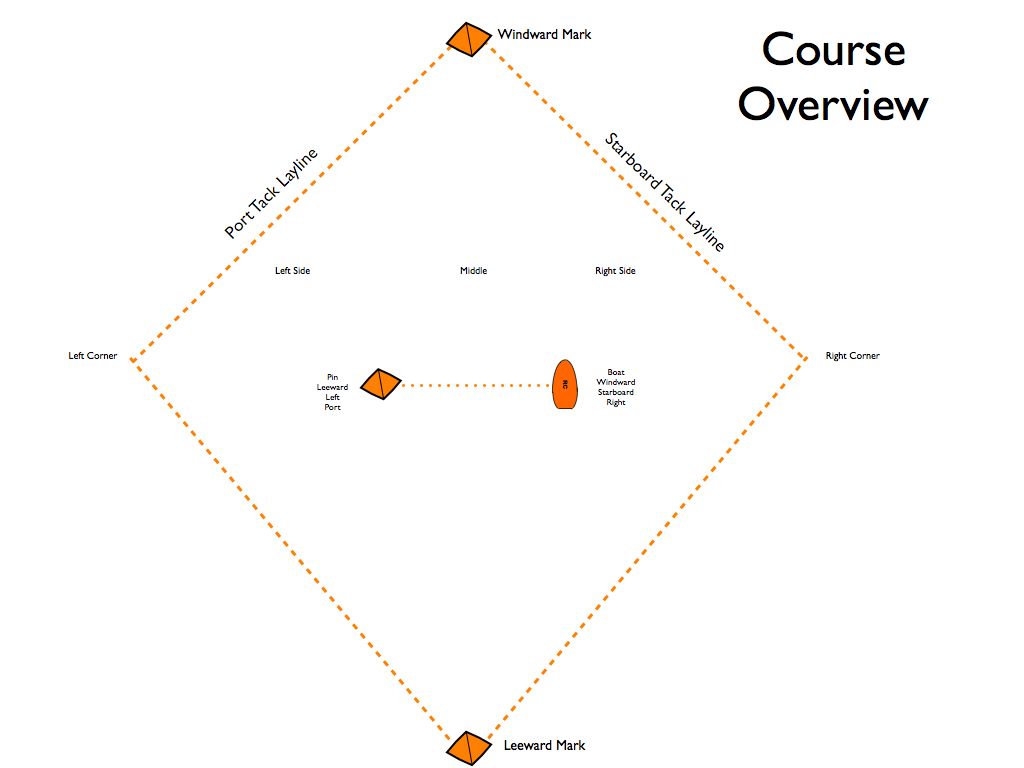
Let’s begin by looking at the race course and develop a language to understand the “anatomy” of the sailing race course.  While there are dozens of course configurations for most racing, we sail on a “drop buoy” windward/leeward course.  All this means is that a group of volunteers drop floating buoys, called marks, in the water.  The buoys are arranged so that they are almost perfectly aligned with the direction of the wind.  The result is that we have an upwind or “windward” mark and a downwind or “leeward” mark.  While other marks may be included, for the sake of this post we will keep it simple and only discuss windward and leeward  courses.

Races have beginnings and endings, therefore we need a start and finish line.  To make it easy on the race committee (and to keep it simple for competitors) the start and finish line is often the same.    One end of the line is often indicated by an orange flag on an anchored committee boat, and the other end is typically a floating buoy that is a different color or shape than the windward and leewards marks.  There are many nicknames for the ends of the starting line, but I prefer to call the starboard end of the line (look upwind) the committee boat end or just “boat end” and the other end of the line the “pin end.”  Other names for the committee boat end of the line include windward, starboard or right and are derived from the fact that most sailors think of the race course in “plan view” looking down on it from above with the wind coming from the top of the page.  Therefore the “pin end” of the line is sometimes called the leeward, port or left end.

Click in the image to see a more detailed diagram of the race course.

The course itself has many parts, each with distinct names that help clarify our discussions.  Thinking in the “plan view” discussed above we can divide the space between the windward and leeward marks both laterally and longitudinally.  For instance if we divide the course into thirds there are left, middle and right sections – or sides – of the race course.  Moving from the leeward mark or start line to the windward mark we have the bottom, middle and upper thirds of the course.  These sections of the courses are important to know and understand because each dictates certain strategic and tactical considerations.  Simply put you need to know where you are and were you are going in order to make a smart choice about how to do it.  Moreover, each section of the course has some pitfalls and opportunities.

To new sailors, this might leave them a little dumbfounded at the multitude of  options a boat could take to get to the windward mark.  But if we think about how boats sail, some invisible boundaries begin to form on our course that make it a little easier to see what is in play and what isn’t.  First, and easiest to understand is the RHUMBLINE.  A rhumbline is simply a straight line between two points.  For instance the line between the windward and leeward marks is a rhumbline.  While no sailboat can sail directly into the wind, most boats including dinghies, keelboats, catamarans, cruisers and racers sail upwind, close-hauled at about 35-45 degrees “off the wind.”  This means that at some point, we can tack and sail our close hauled angle and “fetch” or arrive at a certain point – such as the windward mark.  If we take these courses we would sail to fetch the marks we create another component of the race course – the layline.  These imaginary lines create the “out of bounds” lines for our race course, because any boat that is sailing to a windward mark that sails beyond the lay line is sailing unnecessary extra distance.  Each boat has its own unique tacking angle – or angle between laylines – that will shift the laylines for individual boats.  For instance, an Etchells has a different tacking angle than a Beetle Cat and therefore they have slightly different race courses.  It is important to mention that tacking angles for every boat change with wind velocity and sea state too!

If we turn the course on its head – or round the windward mark and head for the leeward mark – then another set of laylines are formed by the angle between our two optimal gybes.  Because different boats have different optimal gybing angles and because the optimal gybing angle changes radically depending on windspeed the downwind laylines are very fluid.

Now that you have some understanding of the different parts of the race course and the language we use to define it we can begin to discuss how we build a strategic plan that leads to success.  More on the difference between strategy and tactics in my next post.


Frostbite Racing Recap – Week Two

Sail Fast!

Sailing engenders amazing “community”.  There is outstanding information share that takes place because most competitors truly want to race against the best they can and everyone is mutually invested in getting better.  This is one of my favorite things about our sport.  Interestingly, I am not sure that everyone always recognizes how willing our fellow competitors are to share their information, settings, tips and tricks.  Asking good questions is one of the best ways to get better fast.  Walking around the docks and inquiring as to rig settings, controls and techniques arms you with the information you need to “copy the fast people” and move up the ranks quickly.

Below is a copy of a recent email sent out by one of the J/80 Frostbite competitors to the fleet.  Enjoy!

Good morning everyone in the J/80 fleet,
I wanted to pass along something that we used to do in the Laser fleet in Newport that seemed like a fun, easy learning expereince. Before a days racing, a competitor was selected to give a “days recap” of what they saw worked ( What didn’t) and provide a summary. We did it on Thursday nights as well in the J/22 fleet locally and seemed v helpful to try and paint the picture.
Here goes for this week ( Feed free to delete immediately!) 😉
##
Frostbiting #2 – AYC
What a fantastic day with temps in the 60s, light to medium wind and 17 (!) J-80s on the line. No doubt this was a great look on the line with more than a few shorts being sported in the Spring like temps. With a southerly wind coming into the harbor, AYC set a D4 course with a set mark to windward, round to port, round 13 to port and back to the finish.
TIP:   Trying to read the SIs, Eric Menzel who joined us today let us know that his way of remembering which is Hartford and which is Triton light,
Hartford (H) is closer to the Harbor. Best advice we got all day.
Race #1 – Course D4
With a strong current coming into the river, it was critical to get right as fast as possible. With righties coming off the right hand shore, this was even more critical. Vayu, Stacked Deck, and Crush got it right and continued to own the right all the way up the beat. Finding a avenue to get over to the right was difificult with a few going early and reaping the rewards.
After the first mark, it got a little dicey as the puffs off the shore (Now on the left ) seemed tempting, but with a strong inflowing current on the right, there needed to be a time to make the step over. Emotional Rescue made the biggest gains in this leg by stepping however lost most of that by going back for more towards the Navy shore. Ken Magano on the other hand did a great job of playing the pressure and was easilly the biggest mover in the leg. Broad reaching seemed fastest with Stacked Deck (With the help of the Church Key contingent) doing a REALLY good job of sailing low in the light air.
Once the fleet reached 13 and the reach for home, it became more of a parade.
Note: Hat Tip to Rich Harrison – After realizing he rounded one of the marks in the improper way, informed the R/C he would be retiring after finish. Good on ya Rich. More than some respect!
Race #2 – Course C4
This looked like a carbon copy of the first race until The Puffinator made the left work on the first beat.(!) The wind did seem more stable yet the fleet still proceeded to option the right side by the shoal pole. Upon approaching the weather mark, it was the Puffinator who contined left and eventually rounded in the top two. I am guessing their were two things at play here. 1) The breeze filled in more so the puffs from the left were not as critical to a boats sucess and B) The current may have slowed down enought to let the left come into play. Either way, it made them look fanastic. Good on ya!
After the first mark (Rounding to starboard) it was a reach back to the harbor and into the finish. Note. With the tightness of the fleet, no one could make the low road work on this reach with the high folks able to drive down in the puffs.
Skip to toolbar